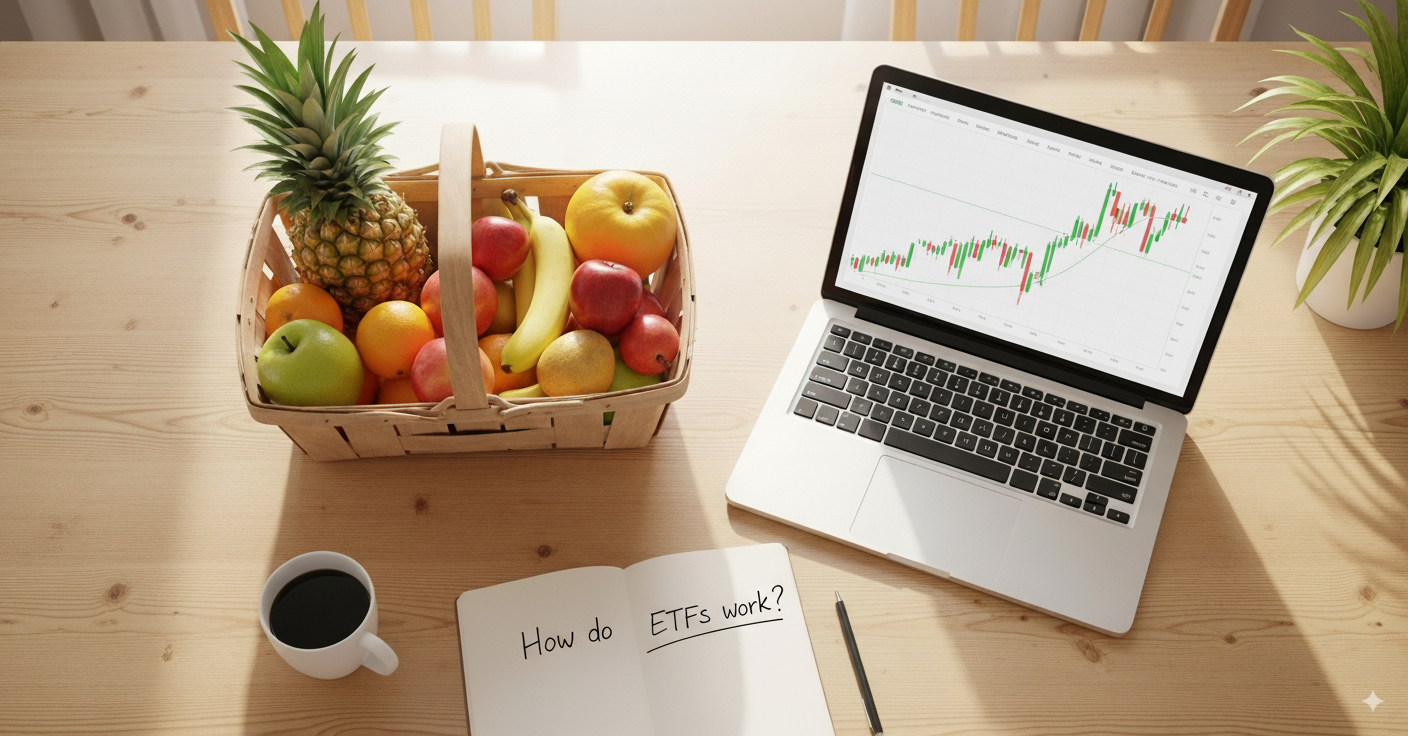
Hey, friends. Alex here.
I remember the first time I heard the term “ETF.” It sounded like some complicated file format, not something I could actually use to build wealth. This is a common feeling, and it’s why so many people ask me, “how do ETFs work for beginners?”
If you’ve ever felt intimidated by financial jargon, I get it. I’ve been there.
But here’s the secret I discovered: ETFs weren’t invented for Wall Street geniuses. They were designed for us—regular people who want a simpler, smarter way to invest.
Today, I’m going to demystify ETFs once and for all, using a simple analogy you’ll never forget.
The Shopping Basket Analogy

Imagine you walk into a giant supermarket called “The Stock Market.”
You could spend all day running down every aisle, trying to pick the single best apple, the perfect orange, and the juiciest banana. This is like trying to pick individual stocks. It’s exhausting, time-consuming, and you might end up with a few rotten apples.
Now, what if the supermarket offered a pre-packed “Fruit Lover’s Basket”?
For one simple price, you get a basket containing a small piece of every single fruit in the store. You get the apples, the oranges, the bananas, and everything else.
That basket is an ETF.

An ETF (Exchange-Traded Fund) is simply a single investment that holds a collection of other assets, like hundreds of different stocks. Don’t just take my word for it. The U.S. Securities and Exchange Commission (SEC), the main regulator of the financial markets, describes ETFs as funds that offer an easy way to buy a diversified portfolio.
It’s the perfect tool for a common sense investing philosophy.
The 3 Big Wins of Using ETFs
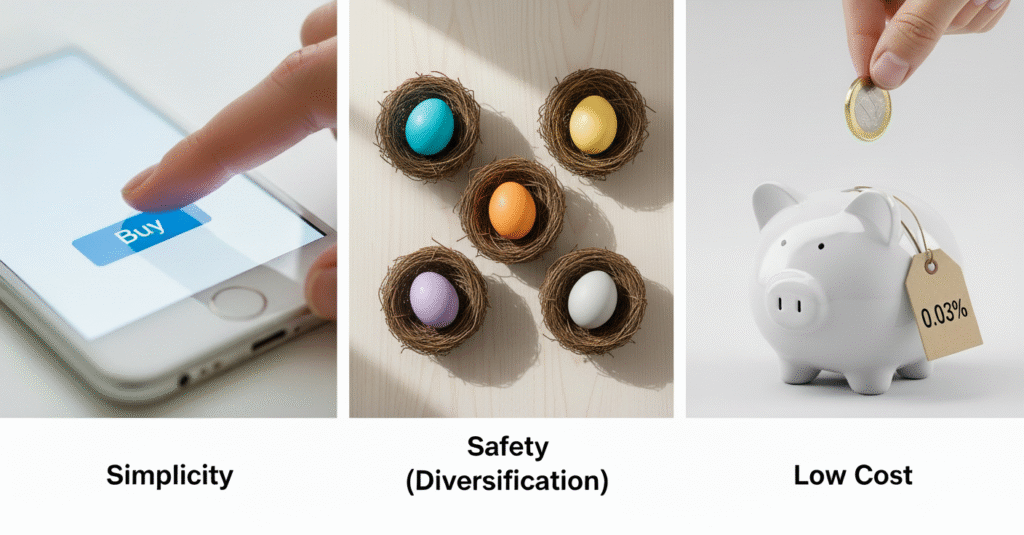
So, why is this “shopping basket” approach so powerful for us? It comes down to three simple, game-changing benefits.
1. Simplicity: One and Done
Instead of researching hundreds of companies, you only need to make one decision: which “basket” do you want to buy?
For most beginners, a single S&P 500 ETF is a fantastic starting point. This one purchase gives you ownership in 500 of the largest, most successful companies in the U.S.
It’s the ultimate “keep it simple” strategy.
2. Safety Through Diversification
This brings us to the biggest superpower of ETFs: Diversification.
By owning a small piece of hundreds of companies, you’re not putting all your eggs in one basket. If one company (one fruit) has a bad year, it has a very small impact on your overall portfolio (your entire basket).
As the financial education site Investopedia explains, diversification is the most important component of reaching long-range financial goals while minimizing risk.
This built-in diversification is your best friend when it comes to handling market volatility, because you’re not overly exposed to the fate of a single company.
3. Low Cost: Keep More of Your Money
Remember our analogy? Buying the pre-packed basket is almost always cheaper and more efficient than buying every single fruit individually.
The same is true for ETFs. They are famous for their incredibly low fees (called “expense ratios”).
This is a huge deal. High fees can silently eat away at your returns over time. By choosing low-cost ETFs, you ensure that more of your hard-earned money stays in your pocket, working for you.
So, How Do ETFs Work for Beginners in Practice?
Understanding the concept is the first step. The next is putting it into action.
The process is surprisingly simple. You open an investment account, you search for the ETF you want (like one that tracks the S&P 500, often with a ticker symbol like “VOO” or “IVV”), and you buy it, just like you would a single stock.
It’s that straightforward.
Your Next Step: From Knowing to Doing

Now you know the answer to “how do ETFs work for beginners?” You understand that they are simple, diversified, and low-cost tools designed for long-term success.
They are the foundation of my own investment strategy, and they can be yours too.
The next logical question is, “How do I buy my very first one?”
Don’t worry, I’ve got you covered. My step-by-step guide on how to start investing with just $100 walks you through that exact process. It takes the mystery out of it and gives you a clear, actionable plan.
If you want a simple map that puts these core principles into one place, I’ve created a resource just for you.
Grab my free [7-Minute Retirement Quickstart PDF]. It’s the simple map you need to start building a future that’s secure.