

Hey, friends! Alex here.
Let’s be honest. When you’re choosing where to put your family’s retirement money, it feels like choosing between two giants. You know they’re the best, but you’re stuck: Vanguard versus Fidelity.
It’s one of the most important financial decisions your family will make. And on the surface, they seem almost identical—two fortresses designed to protect your wealth.
But they have two completely different philosophies, two different souls. And understanding that difference is the key to making the right choice.
Today, we’re cutting through the noise. This isn’t just a specs sheet; this is the ultimate Vanguard vs Fidelity showdown, judged purely on what matters to busy, middle-class family investors.
Round 1: The Foundation – Investment Options & Costs

In our first round, we look at the absolute bedrock: what can you invest in, and how much does it cost? If a platform doesn’t nail low costs, nothing else matters.
The Low-Cost Index Fund Fight
Here at EasyWealthMap, we love the low-cost approach. That means ETFs and Index Funds.
Vanguard is the king here. They practically invented the low-cost index fund. Their flagship is the legendary VTI, which lets you own the entire US stock market.
Fidelity, not to be outdone, offers its own fantastic lineup. They offer funds that track the market almost identically to Vanguard’s.
On cost, they are in a dead heat. A 2025 comparison from Forbes highlights that VTI and Fidelity’s key competing ETFs are virtually identical in expense ratios.
Fidelity’s Knockout Punch
The game changes slightly when we talk about their own branded index funds.
Vanguard’s funds are incredibly low cost. But Fidelity threw a knockout punch a few years ago: they introduced a line of ZERO-FEE index funds (like FZROX). You pay them literally nothing to own the entire US stock market.
This is a huge win for investors. However, here’s the most important takeaway: The difference between 0.03% and 0.00% over your lifetime is incredibly small. In the fundamental round of Vanguard vs Fidelity, it’s essentially a draw. You cannot make a bad choice here.
Round 2: The User Experience – Tech & Simplicity
Alright, Round 2. A powerful platform is useless if it’s impossible to drive. Which one makes your life easier when you finally have five minutes to check on your future?
Vanguard: The Old-Money Guardian
Vanguard is the Old-Money Guardian. Their website is functional. It’s reliable and safe, like an old Volvo. It was designed by brilliant investment managers, which is great, but maybe not by world-class user experience designers. It can feel a little dated.
Vanguard’s entire identity is built on one thing: being the unwavering, low-cost protector of your wealth. This appeals to the investment purist. This deep, pure philosophy is why it perfectly embodies my system for long-term growth: My 1-Hour Rule: Set It and Forget It Investing.
Fidelity: The Modern Family CFO
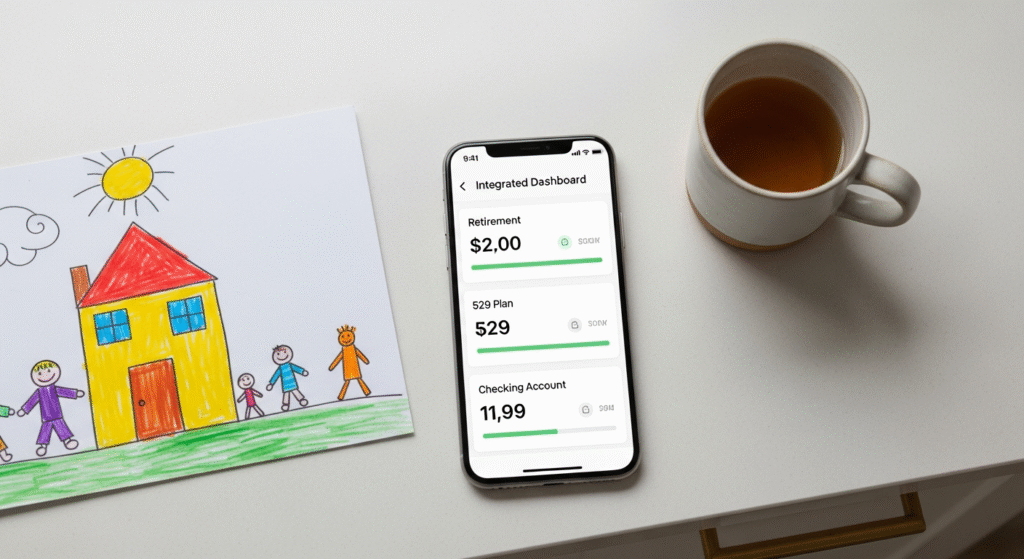
Fidelity is the Modern Family CFO. Their website is clean, modern, and intuitive. Everything is presented on a customizable dashboard.
Fidelity feels less like a financial institution and more like a tech company’s app. For a busy parent who just wants to see “Are we on track?” in 30 seconds, Fidelity’s experience is smoother.
Winner of Round 2: Fidelity. If you value modern design and simplicity, Fidelity has a significant advantage in the Vanguard vs Fidelity user experience fight.
Round 3: The Family Advantage – All-in-One Power
Alright, the final round. Your financial life isn’t just about you; it’s about your kids’ college, your mortgage, and your daily money flow.
Retirement Accounts (The Core)
For core retirement accounts (Roth IRA, Traditional IRA), both are absolutely world-class. They are the giants of the retirement world for a reason.
Both platforms offer incredible low-cost investment options for any Vanguard vs Fidelity portfolio. The simple truth is, you cannot go wrong with either for your core retirement savings. When you are ready to put your money into your retirement account, remember this comparison.
The 529 College Savings Plan
This is where Fidelity shines for families. Both offer excellent 529 plans, but Fidelity’s platform is designed for seamless integration.
You can see your retirement savings and your child’s college fund, side-by-side. For a parent trying to juggle multiple long-term goals, Fidelity’s unified view is a powerful advantage. The cost differences for these plans can be marginal, as seen in the official fee comparison.
The Daily Money Flow
Vanguard has always been a pure investment company; they don’t offer checking accounts or mortgages.
Fidelity does. You can have your investment accounts, your kids’ 529s, and a cash management account that works just like a checking account, all under one roof. This is a game-changer for busy families who crave simplicity.
Winner of Round 3: Fidelity. In the battle for the all-in-one financial partner, Fidelity wins the Vanguard vs Fidelity family advantage.

The Verdict: Which Platform is Right for YOU?
The scorecard seems to point towards Fidelity, but the best platform is the one that fits your personality and life.
Choose Vanguard if you are a Purist. You believe in doing one thing and doing it perfectly. You want an investment-only company with an unshakable reputation for low costs. You actually prefer to keep your banking and investing separate. You value purity above convenience.
Choose Fidelity if you are a Pragmatist. You want a powerful, modern, all-in-one solution for your entire family’s financial life. You love technology that simplifies complexity. As one analysis puts it, the choice between Vanguard vs Fidelity really comes down to whether you prefer an investment fortress or a unified financial center.
Here’s the beautiful truth: there is no wrong answer here. These are the two best options for building your family’s wealth using a simple strategy like the Lazy 3-ETF Portfolio.
Your Next Step is NOT Choosing
So now you have the framework. You know which one probably fits you better.
I’m going to tell you something that might surprise you: Your most important next step… is NOT to spend another week choosing between them.
The real victory is not in picking the “perfect” platform. The real victory is in starting.
If you’ve made your choice, your next step is to open the account! If you’re still wrestling with the final decision, Investopedia has a good decision-making framework here.
Your Action Plan Awaits: Ready to stop choosing and start building? I’ve distilled my entire blueprint and simple tools into a free PDF guide.
👉 Click Here to Grab My FREE “7-Minute Retirement Quickstart” Guide!
Now stop choosing. Go start building.